From Simulation to Physical Validation: What DELMIA Reveals Before Deployment
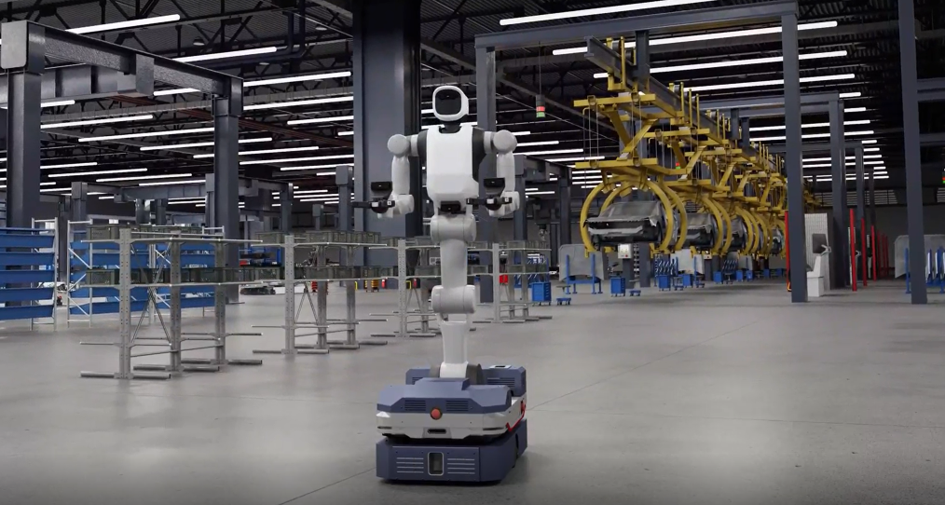
/ 4 min readAt NVIDIA GTC Berlin, a joint use case with Audi shows how this environment can help assess the role of an adaptive robot within a production and logistics system before deployment. The mobile humanoid uses policy-based automation to respond to variations in the task and environment. DELMIA provides the virtual setting in which we can examine this behavior alongside the surrounding production process.
Virtual twins allow teams to compare configurations earlier, focus physical testing on relevant scenarios and reduce the risks associated with layout changes. This shortens the path from planning to deployment.
A robot model is only the beginning
The first step in DELMIA is to bring the robot and factory environment together. The virtual twin of the workcell can be assembled from 2D and 3D layouts, product data and CAD as well as scans, images or videos. The robot model adds the dimensions, joints and movement capabilities of the mobile humanoid, while racks, components and other equipment complete the scene.
Accuracy is a key component in this process. A rack positioned a few centimetres away from its actual location may change the robot's approach, while missing component details may hide problems with the grasp. Once the elements are in place, we can assess how space, equipment layout and the process sequence constrain the robot's movements.
Trying the task before deployment
Inside the virtual workcell, the mobile humanoid can begin the planned handling sequence. The team can examine questions such as:
- Can the robot reach the component from its intended position?
- Does the gripper have enough space?
- Can the mobile humanoid approach the rack without interfering with nearby equipment?
DELMIA shows how changes in a component's position or orientation affect the grasp, whether a movement takes longer than expected and whether a layout adjustment provides a better approach path. Robot movements, workcell geometry and process sequences can be viewed together, allowing teams to compare configurations before equipment is moved or installed.
The simulation also provides an initial indication of cycle time and identifies the steps with the greatest influence on it. This helps focus further development and physical testing on the most promising configurations.
Scaling the simulation to the factory floor
A robot working successfully at one station can still be affected by processes around it. It may have to wait for a component, an autonomous mobile robot may arrive late, or another system may need access to the same area.
DELMIA expands the simulation from a single workcell to the wider logistics environment, including additional stations, mobile humanoids, autonomous mobile robots and material flows. This allows teams to ask:
- How does an additional robot affect material flow?
- Where could waiting times or bottlenecks develop?
- How do multiple robotic systems and different layouts affect throughput?
These scenarios connect the robotic task with production and logistics planning and provide an early basis for considering deployment scale, costs and potential return on investment. They show whether the mobile humanoid can operate within the available space and timing of the overall logistics process.
Exploring adaptive robot behavior
The mobile humanoid is designed to use AI-based control policies that allow it to respond to variations in a task or environment. DELMIA provides a controlled setting in which teams can simulate these variations and assess their effects on the robot and the surrounding production process.
In the GTC Berlin use case, DELMIA leverages NVIDIA Omniverse libraries and OpenUSD, providing technologies for physics, visualization and the exchange of virtual-world data.
With the virtual twin of the production system, the impact of the robot's adaptive behavior on the wider production process can be assessed. A policy may complete the handling operation successfully, while the system-level simulation reveals that its timing could create a bottleneck elsewhere. DELMIA therefore shows how changes to the robot, layout or process affect the overall result before physical testing begins.
More information about DELMIA: DELMIA Global Operations Software | Dassault Systèmes